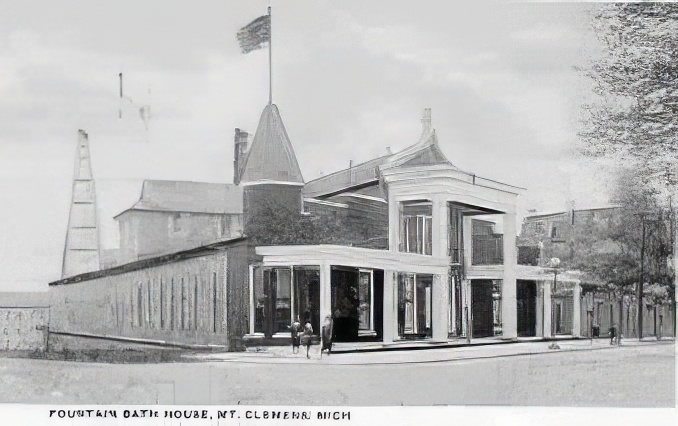
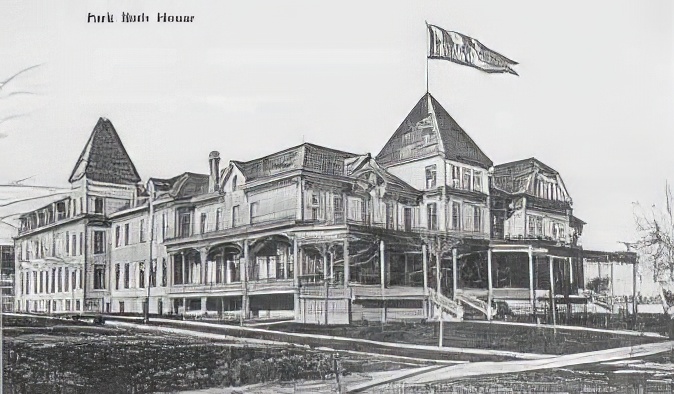
Mount Clemens, Michigan The Bath City of America 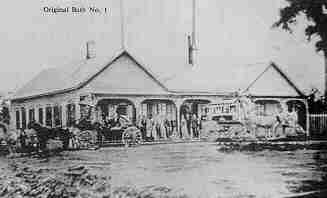 The first bath house in Mt. Clemens, called the ORIGINAL, was constructed in 1873 and marked the beginning of the city's fabulous bath era, the city later to become known as the "Bath City of America," and famous around the world. In 1870 a Mount Clemens flour mill proprietor, Dor Kellogg, had cured his severe case of eczema by bathing in the salty mineral water, and a local physician, Dr. Abner Hayward, had started prescribing bathing for his patients suffering from rheumatism. Interest in the curative powers of the city's mineral waters continued, and as a result Dr. Henry Taylor, another Mount Clemens physician, built the first bath house so that the mineral-rich waters could be pumped from the wells into large tubs. Always known as the ORIGINAL, Mount Clemens' first bath house was located in the southeast corner of what is today known as McArthur Park. Financed by contributions from the citizens of Mount Clemens, a Mineral Springs Company was formed with Dr. Henry Taylor, his son, Dr. Henry Taylor, Jr., and E. W. Lewis as guiding lights. In 1877 the ORIGINAL was taken over by Seth D. North of Hancock, Michigan, and Charles R. Johnson of New York who added 46 tubs. The 1901 Cutter's Guide gives credit to North & Johnson for providing the capital to develop the mineral baths. For many years, the ORIGINAL was the only bath house in town. Baths were given for 50 cents without an attendant and 75 cents with an attendant. The arrangement of the building was strictly for the comfort of the guests and later, around 1880-81, was connected with the Avery House and Hotel Egnew by enclosed and heated passageways for the convenience of patrons. The Messrs. North & Johnson were the proprietors of the ORIGINAL with Mr. Frederick G. Kendrick the business manager. The ORIGINAL continued to prosper until it burned to the ground on August 23, 1883. It was promptly rebuilt and reopened on January 15, 1884. 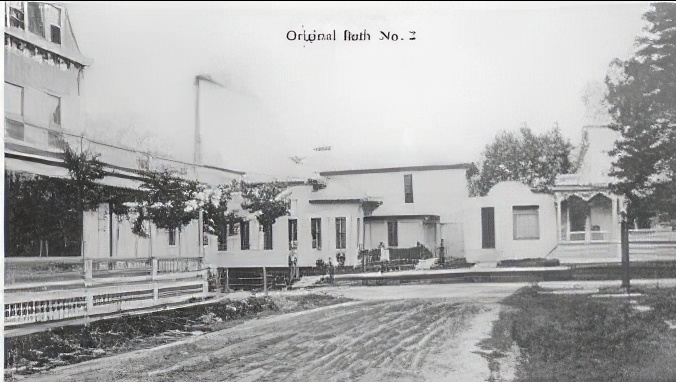 This new facility could handle 500 baths a day with its 58 tubs. Up to July 1, 1893, 750,000 had been given. In 1899 the entire complex consisting of the ORIGINAL and the two adjoining hotels ( Avery and Egnew) was sold by North & Johnson to the ORIGINAL BATH AND HOTEL COMPANY, whose officers were Fred G. Kendrick, president; Silas B. Spier, secretary; and George A. Skinner, treasurer. In January of 1902 fire again claimed the building. This time it was rebuilt as the NEW ORIGINAL BATH HOUSE AND SANITARIUM and was connected to the Egnew Hotel. Dr. Richard Leuschner was the medical director and Mr. H. O. Henderson the proprietor whose other hotel experience aided in catering to the comfort and pleasure of the guests.   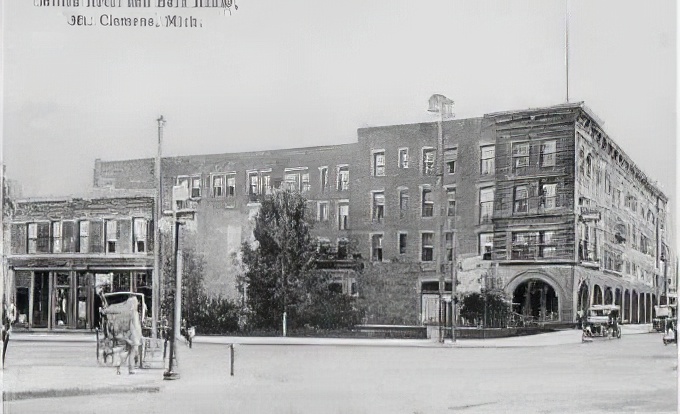 Built in 1882, the MEDEA became Mount Clemens' second bath house and was located at 19 South Gratiot, near the corner of Cass Avenue. Named after the Greek mythological sorceress Medea who was believed to have magical powers, it was built and operated by the Mount Clemens Bath Company whose members were William J. Daley, Charles Nimms, Charles H. Parsons, Thomas Fitzgerald and Spencer B. Russell. In 1882 they established the Medea Springs which supplied the mineral water for the bath house. The bath section was equipped with solid porcelain tubs of large size, the bath rooms partitioned with white Italian marble, the floors of vitreous tiling, all offering a high degree of beauty and sanitation. The new bath house flourished, so in 1899 the Mount Clemens Bath Company acquired all of the property north to Court House Square and built a 150 room hotel which opened to the public on June 6, 1904. The principal stockholders were now Paul and Adam Ullrich, as well as Mr. Daley and Mr. Russell. The number of baths continued to increase, as evidenced by the number given in the month of July, rising from 4,869 in 1890 to 6,748 in 1891 and to 7,681 in 1892. The bath house was rebuilt in 1891 with 150 porcelain tubs that could accommodate 1,500 baths a day. It was pretentious for the time and was one of the largest bathing establishments in the world. The price of a mineral bath, however, was reasonable in the early days, 50 cents each and 25 cents more for the services of an attendant. The four-story MEDEA Hotel combined several styles of architecture. Romanesque on the first level, the design included a 180 foot segmental arch with circular end arches, classic stone cornices and Gothic moldings. As described in Eldredge's Macomb Couny History (p. 126), the construction was "...of brick, stone and steel, is practically fire-proof. The ten massive arches forming the first story of the Gratiot Street frontage are of Lake Superior red sandstsone, and enclose an arcade porch one hundred eighty feet in length by sixteen feet in width. The same stone is used with red pressed brick in carrying up the entire front of this building, giving a rich and massive effect." Three generations of the Ullrich family were associated with the MEDEA Hotel and Bath House. Paul Ullrich's son, Paul J. purchased Adam Ullrich's interest in 1902 and was to serve as manager for a long period. Matthew Slush was a stockholder at one time, but in the early 1930's the Ullrich family bought out the minority interests and became the sole owners. Marcus, John and David Ullrich, sons of Paul J. were active in the business at various times until it was sold to the Priehs Realty Company in 1955. Unfortunately, with the decline of the bath industry, the MEDEA fell upon hard times, was poorly maintained, neglected, vandalized, and demolished in 1991. It was especially noteworthy for the long array of beautiful arches that covered a walkway along South Gratiot. With its demise, a long-time Mount Clemens landmark and the last of the downtown bath houses disappeared. The FOUNTAIN gave special attention to ventilation and offered larger rooms and tubs for those guests so badly crippled as to have difficulty bathing in the usual tubs. A gymnasium was provided for all patrons. According to the 1904 Cutter's Guide, improvements made to the FOUNTAIN included solid porcelain tubs, tile and mosaic floors, marble wainscoting and partitions. It was the second largest in the city, having 70 bathrooms, 40 cooling rooms, ladies' and gentlemen's parlors, physician's office and a rotunda or general reception room over 20 feet wide by 56 feet long and ceilings 24 feet high. The private cooling rooms assured perfect privacy to bathers. The FOUNTAIN mineral wells were one of the deepest wells in the city and were located just back of the bath house. Their advertisement read "The price of baths is the same as at all the houses, 50 cents for mineral water, 25 cents for mineral foot bath, and 75 cents for mineral vapor. Fresh water bath 25 cents. Attendants fee 25 cents extra." The FOUNTAIN Bath House was said to be one of the most complete and cheerful in the city, capable of bathing 500 patrons daily. A star feature of the bath house was the 40 individual cooling rooms which were in a separate hall, large and well-ventilated. A steam laundry was included, as most bath houses found it necessary to run their own laundries to wash the vast number of towels and blankets used by the bathers. The FOUNTAIN Bath House was the site of the first electric lights in the city using their own private generator in 1888. In 1913 the derrick over the mineral well collapsed into the street. Mineral water had a deteriorating effect on wood in the near vicinity. It is not known if there were any injuries. Queen Anne porches with oriental balustrades were distinctive features of the FOUNTAIN Hotel at 124 North Gratiot. The hotel was in connection with the FOUNTAIN Bath House via a heated passageway under the Crystal House at 122 N. Gratiot, then under Clinton Street and up a stairway into the Bath House. The Clifton House, located at 56 Market Street, was also connected to the FOUNTAIN Bath House by an above ground enclosed passageway. The FOUNTAIN Hotel was the site of the first elevator in Mount Clemens. On New Year's eve in 1924, the hotel burned down in a very spectacular fire. At the time, the building was closed for the winter and there were no known injuries. The White Star Hotel next door, formerly the Crystal House, was extensively damaged. The FOUNTAIN Bath House operated until 1938 when it closed and the building was demolished. An A&P grocery store was built there in 1939. In 1887 Margretha Kieffer, from Buffalo New York, brought her ailing daughter to Mount Clemens with the hope that a course of mineral baths might bring a cure. They stayed at the Central Park Hotel at 61 East Street. The daughter passed away, but Mrs. Kieffer, a sharp business woman, chose to stay and invest in the hotel. In partnership with her son-in-law, Benjamin McArthur, they purchased the Central Park Hotel and changed its name to Park Hotel. In 1892, Margretha's husband, John, became the partner of William Burgard and together they built and operated a new bath house which was connected with the Park Hotel. A very large, 3-story, 200 room addition was completed in 1898. The PARK Bath House and Hotel were the most expensive, with wide spacious verandas and pleasant halls, affording continuous promenades. The interior was furnished most sumptuously, with splendid lobby, wide corridors, and many rooms with private bathrooms for every comfort, convenience and luxury of the guests. The bath house and hotel were under the same roof, doing away with exposure to outside air and long tedious passageways. It was considered one of the finest bathing institutions in the country, with marble floors, partitions, wainscoting, private cooling rooms and every latest improvement. This bath house and hotel offered a gymnasium, bowling alley, bar and card rooms in the basement, and there was an elevator for the guest's convenience. A grand eighteen foot wide hallway led from the hotel to the bath house, where, by 1928, nearly half a million mineral baths had been given. The PARK became the social center of Mount Clemens and was the scene of many fabulous parties and balls. Known for its luxurious accommodations, the PARK hosted many affluent and famous personalities including Henry Ford, George M. Cohan, Mae West, Booth Tarkington, William Randolph Hearst, Helena Rubinstein, Jerome Kern, William Jennings Bryan, Alice Roosevelt and Fannie Hurst. In 1911 the proprietors purchased the grounds formerly occupied by the Avery Hotel which had been destroyed by fire. It was located across the street from the hotel, between Jones and Park Street. They converted the area into a lovely picturesque park with fountains, flowers, shrubbery and paths. The park was built for the comfort and relaxation of the PARK Hotel patrons. Benjamin McArthur passed away in 1899 and his wife Julia Kieffer McArthur assumed his interest in the hotel. John Kieffer passed away in 1900 and the bath house partnership passed to his son, George H. Keiffer. When Margretha Kieffer died in 1911, she left her interest in the PARK Hotel to her daughter Julia. Business declined slowly after the depression of 1929. By 1937 the hotel was listed as vacant. Considered hazardous because of neglect and vandalism, the hotel was demolished in 1940. A USO Recreation Center was built there and was converted into the Mount Clemens Civic Center after World War II. The COLONIAL was a large structure with broad verandas encircling two sides that added charm and distinction. The style of architecture, no doubt, later gave it the name of the COLONIAL. It was built entirely of brick and stone, with special attention give to sanitary details, drainage, ventilation and plumbing. The main building, five stories high, was a stately structure with wide porches and several beautiful white columns. In 1906, a large addition was constructed on the south end of the hotel which included another entrance and a ramp for invalids. A very attractive feature was the roof solarium where guests could bask in the sunshine. There was also a sun parlor which was furnished with couches, easy chairs and beautiful rugs.
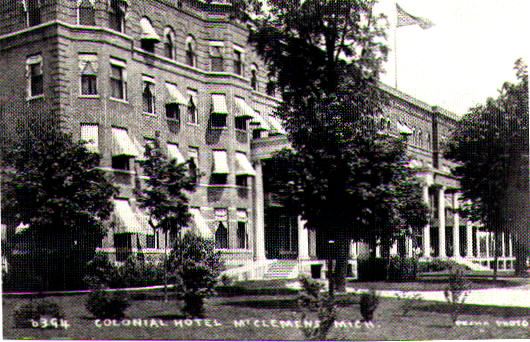 The bath house was connected to the sanitarium by closed corridors, well-warmed and lighted. Most of the rooms were arranged en suite with private toilets. Modern elevators made all tooms desireable and readily accessible. Floors were covered with movable rugs to absorb sound. The medical direction was under the supervision of Dr. A. N. Shotwell, a leading Mt. Clemens physician who had many years experience using local mineral water in the treatment of many diseases. Trained nurses were in attendance for guests who required special care. Dr. Shotwell had been associated with Emma and Ida Lilly of Indianapolis, Indiana, in the building of the COLONIAL. The Lilly sisters had been long-time visitors to Mt. Clemens, and Emma lived in the hotel for many years. Plans for the COLONIAL were by T. Van Damme, the popular architect and it was erected under the supervision of Charles C. Lamb and George H. Nichols. The plumbing and heating work was done by A. F. Glover and the electrical work by Electrical Engineering Company of Detroit. Beginning in July, 1901, Edwin R. Egnew served as manager, and a number of years later Webster W. Witt assumed the position of manager. Eventually, control of the bath house and hotel passed on to Dr. Gustaf A. Persson who had been medical director of the Park and COLONIAL Bath House. Dr. Persson had plans to build a new bath house on the banks of the Clinton River in the Breitmeyer subdivision, but this project was later abandoned. In its place the Persson Foundation was formed to operate the COLONIAL and conduct research on the cure of rheumatism. Dr. Persson died in 1934, and in 1935 his widow sold the COLONIAL to a New York syndicate that hired Max Elkin of Mt. Clemens to be their manager. Over the years, there were various projects to try to renovate the majestic facility and bring it up to present-day codes, but none proved successful. On May 31, 1984, firefighters from seven departments could not save the once elegant and historic COLONIAL from destruction by fire of "suspicious origin." The site now is the location of a drug store.
The Olympia Bath House was considered to be one of the most handsome bathing establishments in the country. The Olympia opened its doors on June 1, 1903, and was located at 84 Cass Avenue next to the Fenton Hotel, an exellent location on one of the main and shady streets of the city. Considered one of the most architecturally interesting structures relating to the bath industry, the Olympia Bath House was constructed of white glazed brick with stone trim. The Corinthian-type columns and pilasters rising two stories over the entry gave it a most impressive appearance. Charles H. Parsons and Thomas E. Matthews were the proprietors. The lower floor was entirely devoted to bathing, office, reception rooms and halls. The upper floor was divided into a dozen or so commodious rooms for the patrons who desired or needed to be close to their baths. The lobby was both spacious and elegant, floors laid in the most beautiful tiling, and furniture and appointments selected with rare taste and judgement with consideration given to durability as well as beauty. A sizeable verenda facing Cass Avenue, supplied with numerous rocking chairs, gave guests the opportunity to relax, visit, and watch all the activity on this busy thoroughfare. This bathing establishment had Italian marble partitions and wainscoting, 40 porcelain tubs, each 7 feet and 6 inches long insidee. There were two vapor baths and 32 private cooling rooms, two gymnasiums and private rooms for the attendants. 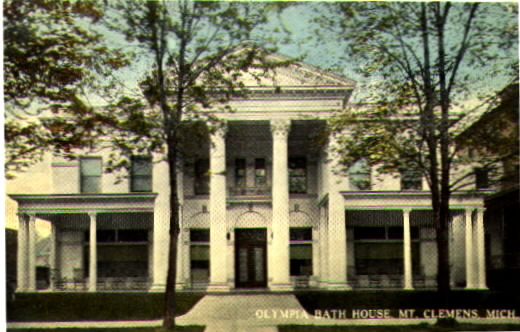 The ladies section was at the left of the building and consisted of reception, cooling and dressing rooms, bath-halls, and bath rooms. The gentlemen's section was on the right side and substanttially the same. Every kind and style of bath obtainable elsewhere was available at the Olympia and at the same rates prevailing throughout Mount Clemens. The depth of the mineral well at the Olympia was 1,265 feet and its complete composition with mineral analysis, temperature and related details was available. In 1910 the Olympia Company was capitalized for the purpose of purchasing Hotel Fenton. The entire front the Fenton Hotel was rebuilt in bricks with a sun room on the front porch. The name of the hotel was also changed to the Olympia. In 1925, the Elkin family (father Samuel, sons Max and Joseph), purchased the Olympia. Samuel Elkin had come to Mount Clemens in a wheelchair about 1907, took the baths, and remained to go into business. About 1936 the Olympia Hotel and Bath House were purchased by Samuel Kraemer who previously had owned an establishment at 25 South Avenue and 89 Cass. The Kraemer family operated the Olympia until it was purchased by the city and torn down in 1955 to make a parking lot. The parking lot was recently rebuilt and is named "The Roskopp Parking Lot." 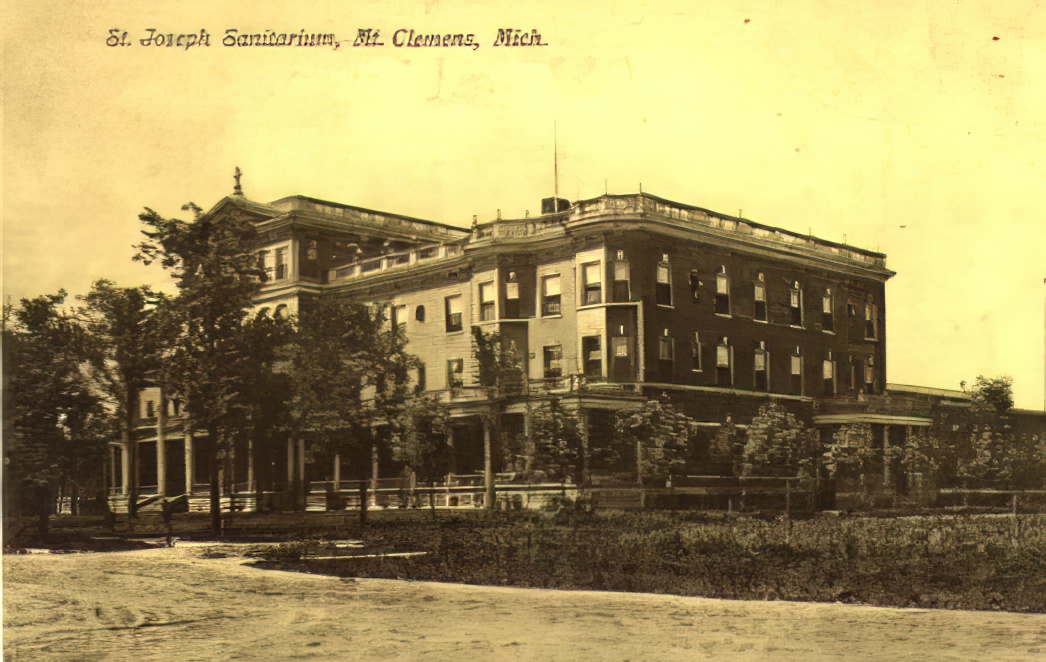 As of 1998, the St. Joseph Sanitarium located at 215 North Avenue, is the only remaining bath house in Mount Clemens. Built by the Sisters of Charity of St. Joseph, Cincinnati, Ohio, it was dedicated on November 21, 1899. One of the Sisters had come to Mount Clemens for the baths, was successfully treated, so suggested a sanitarium to be built. Four Sisters were sent to oversee the project, and ground was brokeen on November 2, 1898. The St. Joseph Sanitarium was the major work of the well-known architect Theophilus Van Damme. Albert Brechler of Mount Clemens was the contractor for this building project, one of the city's largest, costing more than $175,000. The 1911 Cutter's Guide described it as "...of brick, three and four stories high, the main building fronting the east and more than 200 feet long, two ells of the same length run to the west ... giving rooms opening to every point of the compass." Many out-of-town dignitaries attended the dedication ceremonies held in the afternoon followed by an elegant banquet at five o'clock. The local Lee Printing firm printed the elaborate dedication programs. The rector of St. Peter's Church, the Rev. J. A. VanHoomissen, was given much credit for the project, for he had also dreamed of such an establishment for years. An advertisment of 1913 states that the sanitarium is "...elegantly furnished and equipped throughout with all modern and surgical appliances for the administration of the SULPHO-SALINE MINERAL BATHS, the waters of which are admitted to be the STRONGEST AND MOST POTENT known to therapeutics in the treatment of chronic diseases. ... the courtest of the Mineral Baths is extended to all physicians FREE OF CHARGE ... Instructions from physicians sending patients to the Sanitarium will be faithfully followed and all patients are advised to take the baths under the direction of a physician if possible" The bath house, connected to the main building by heated hall, embodied all the latest appliances and improvements ... hardwood finish, floors, solid porcelain tubs, private cooling rooms with cots for rest, lockers for clothing, and every convenience for the comfort of bathers. A parlor was provided for transient bathers. The large generously furnished rooms and suites of the sanitarium created a feeling of relaxation and restfulness. A spacious library and reading room, handsome lobby and broad veranda gave ample space for exercise and amusement. In 1900 the Sisters of Charity set aside the third floor as a 50-bed hospital, and by 1952 the mineral baths were completely phased out. The Sanitarium has had a number of additions so as to accommodate more hospital patients and medical facilities. The original bath structure, however, remains in magnificent condition and has been wonderfully maintained. With its high ceilings, impressive pillars, beautiful oak woodwork and staircase, its elegance is a testament to a bygone era. In 1986, the Michigan Historical Commission placed St. Joseph Hospital and Bath House on the Michigan Register of Historic Places in time for the 150th anniversary celebration of Michigan statehood. The Macomb Daily of Monday, November 17, 1986, featured an article "Hospital Earns a Place in History," and quoted phrases from the Michigan History Division, " ... a three-story E-shaped building of Classical Revival architecture; ... the huge open porch on the main floor was a grandiose expression of the era's love of porches on homes and hotels; ... the original second story porch is enclosed and topped by Ionic columns; ... the fine architectural touches of the building include round arches and rectangular window enframements, medallions, cartouches and dentils."
In 1990 ownership of the St. Joseph Sanitarium and hospital complex was transferred from the Sisters of Charity to the Mercy Health Services. In 1993 St. Joseph Sanitarium received an Historical Marker from the Mount Clemens Historical Commission as well as the much larger Historical Marker from the State of Michigan.
|